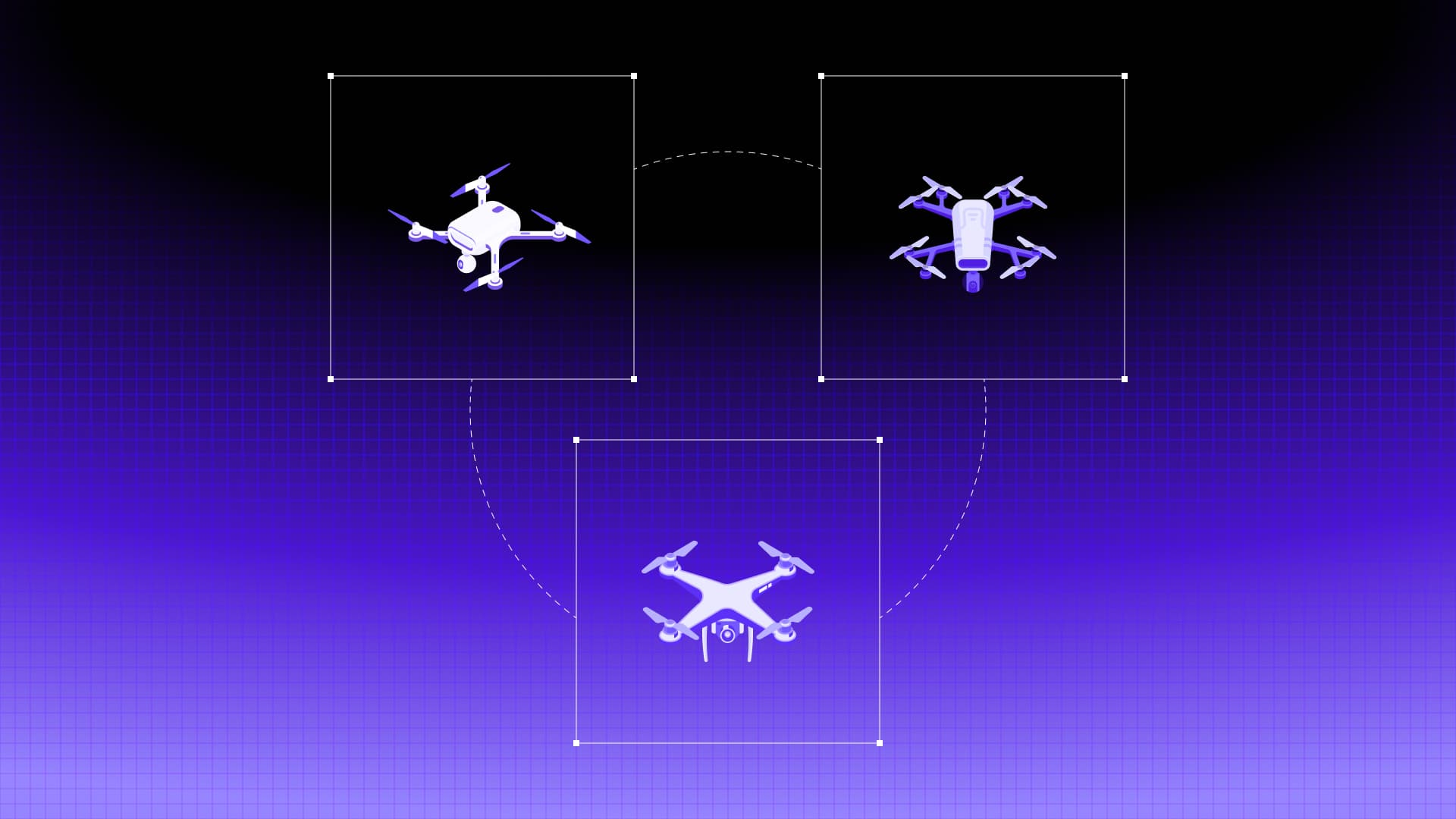
Drone collaborative missions involve multiple drones operating in coordination to accomplish a shared objective. Unlike single-drone operations, these missions depend on structured communication, coordination mechanisms, and distributed decision-making.
Coordination is a mission problem, not a vehicle problem
In collaborative missions, drones rarely act independently.
They follow shared rules:
- When to start
- Where to go
- How to sequence actions
- When to stop
The complexity does not come from flying. It comes from coordination under constraints:
- Limited airspace
- Payload dependencies
- Timing requirements
- Safety boundaries
Teams that approach collaboration by tightly coupling logic to individual drones often run into scaling issues. Each new vehicle, sensor, or hardware revision increases integration work. Teams that succeed treat collaboration as a mission-level concern.
The hidden cost of hardware-centric mission design
Many collaborative missions are built directly around specific drones:
- Hardcoded parameters
- Platform-specific behaviors
- Custom integrations per vehicle
This works - until hardware changes. When a fleet evolves, teams often discover that:
- Missions must be rewritten
- Coordination logic breaks
- Validation has to restart from scratch
The mission did not fail. The coupling between mission logic and hardware did.
A shift toward mission-centric collaboration
Increasingly, teams are separating: "What the mission needs to accomplish" from "How individual vehicles execute their part"
In this model:
- Missions define objectives, constraints, and sequencing
- Vehicles act as execution resources
- Hardware differences are resolved at deployment time
This allows the same collaborative mission to:
- Run on different drone models
- Scale fleet size up or down
- Adapt to new sensors or payloads
without changing the mission itself.
What defines a collaborative drone mission
A collaborative mission involves a team of drones working together, sharing information in real time to achieve a predefined objective. These missions are characterized by:
- Autonomous coordination, where drones communicate status and adjust actions
- Scalability, accommodating many drones as mission size grows
- Redundancy, so if one drone fails another can cover its role
- Shared data collection, enabling richer situational awareness than individual flights could provide
In practice, this means multiple drones fly in structured patterns, divide coverage tasks, and continuously exchange data rather than operating in isolation.
For example, in search-and-rescue missions, drones partition a large search area so that each unit explores a distinct region simultaneously and shares findings dynamically with the rest of the fleet.
From collaboration to reusability
Once missions are defined independently of hardware, something important happens - they become reusable assets.
A mission that coordinates:
- Survey coverage
- Material transport
- Inspection routes
can be redeployed:
- In new locations
- With different fleets
- Under new constraints
The mission evolves. The logic remains.
What is the future for drone autonomous mission?
Drone collaborative missions have moved beyond controlled experiments and showcase demonstrations. Today, they are applied in real operations to execute complex, multi-stage tasks across industries: agriculture, logistics, and disaster response.
As teams scale these operations, a new challenge becomes increasingly visible. Reusability, validation, and portability are no longer optional qualities. Rebuilding missions from scratch for each deployment introduces hidden costs: not just in development time, but in repeated validation cycles and the effort required to adapt mission logic to different hardware integration requirements. Over time, this fragmentation slows iteration and limits operational consistency.
This reality leads a practical question as collaborative missions become routine rather than exceptional: "What if there were a platform that lets you build a mission once and deploy it across different hardware?"
Not as a feature promise, but as an operational necessity.