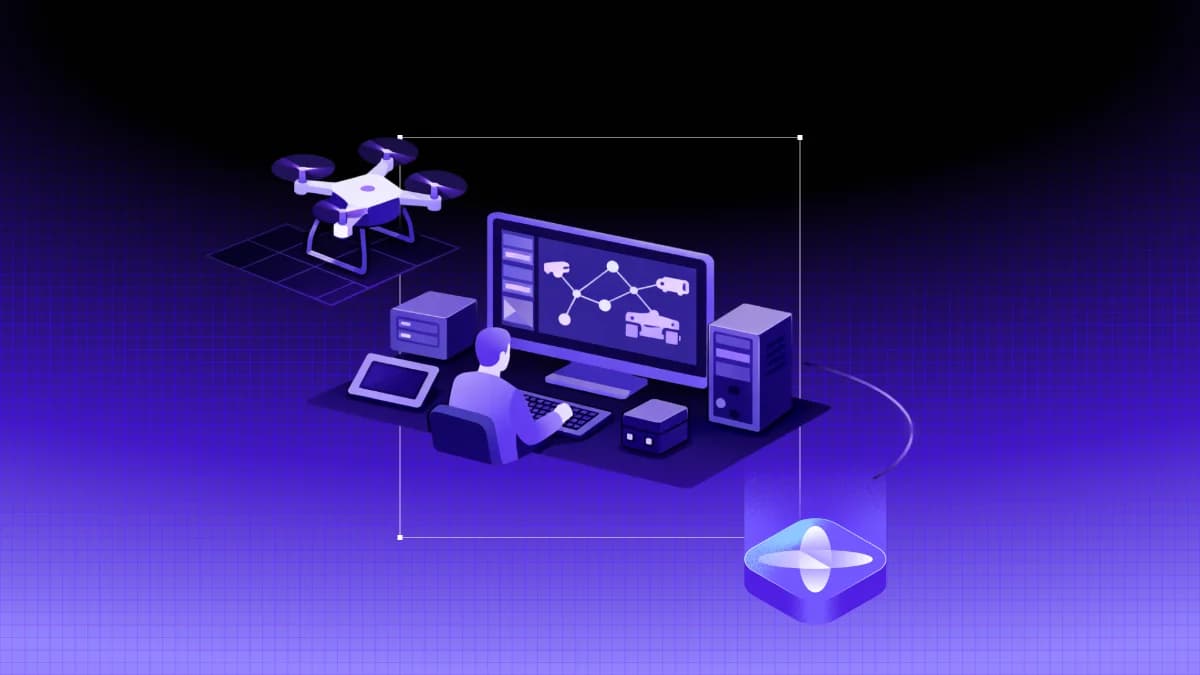
A prototype to production drone workflow becomes difficult the moment a working prototype has to become a repeatable operational program. In the prototype stage, a mission can succeed because the environment is controlled, the team is small, and the people running the workflow are usually the same people who built it. Production changes the standard completely. Now the mission must survive repeated execution, operator handoff, hardware variation, and real field pressure without turning into duplicated logic or fragile workarounds. SkyTrack’s public product story maps closely to that transition because it frames the platform around Mission Studio, Device Onboarding, and Fleet Management within a design-simulate-deploy lifecycle for real-world autonomous missions.
The real shift is not from “prototype” to “more flights.” It is from technical proof to production discipline. That means a prototype to production drone workflow must include stronger validation depth, clearer operating roles, and a software layer that keeps mission logic reusable as the mission moves toward real deployment. SkyTrack’s public pricing reinforces this progression by positioning Community as the foundation, Builder as the tier for growing teams and serious projects, and Scale as the tier for commercialized and mission-critical operation at scale.
Why a working prototype is not yet an operational program
Prototype success hides the cost of repetition
A prototype often looks more mature than it really is because repetition has not yet exposed its weaknesses. One aircraft, one route, and one expert operator can hide a surprising amount of missing structure. Route logic may live inside one person’s head, exception handling may still be improvised, and validation may rely more on familiarity than on documented readiness. That is acceptable for learning, but it is not enough for production.
This is where sim to real drone deployment starts to matter differently. The question is no longer whether the mission can run once. The question is whether the same mission can be repeated under changing conditions with predictable behavior and less dependence on the original builder. SkyTrack’s About page reflects this shift directly by emphasizing mission-first development, hardware freedom, pre-flight validation in digital twin environments, and cross-platform deployment from drones to other robot types.
Production introduces accountability, not just scale
A larger deployment does not only add more drones. It adds more responsibility. The mission now has to be understandable to more people, resilient across more environments, and stable enough that failures do not become operational habits. That is why simulation to production robotics should be treated as a production-systems problem rather than as a simulator problem.
SkyTrack’s public FAQ and pricing language support that interpretation. The company says its pricing model is structured around development velocity, operational responsibility, and scale of real-world deployment, and it describes the Scale tier as suitable for commercialized and mission-critical operation at scale. Those are not prototype criteria. They are production criteria.
What changes when a drone workflow moves toward production
Mission logic must survive more than one environment
A prototype to production drone workflow starts to break when the mission is silently rewritten at every stage. One version exists in simulation, another in field testing, and another in operations because the original workflow was never portable enough to survive the move. That kind of duplication is one of the fastest ways to create brittle operations.
The better path is to keep mission logic portable enough that improvements made during design, testing, and validation stay attached to the mission itself. SkyTrack’s public messaging points exactly in that direction. Its homepage says Mission Studio reduces development time by designing a mission once and deploying across hardware, while the About page says SkyTrack shifts development from hardware-first to mission-first and offers “write once, deploy anywhere.”
Production readiness depends on process hardening
Process hardening is what turns a mission from an experiment into an operational asset. That includes clearer readiness checks, stronger sequencing discipline, more explicit exception handling, and a better understanding of what conditions make the mission safe or unsafe to run. Without these layers, a team may scale activity without scaling reliability.
This is one reason mission operations software matters so much in production. Operations software is not just about live control. It is about preserving mission context after the prototype stage ends. A platform that connects mission creation, device onboarding, and fleet-level oversight gives teams a much better chance of keeping those processes aligned as deployment grows. SkyTrack publicly structures the product around exactly those three layers.
Validation depth is what separates technical proof from production discipline
Sim to real drone deployment must validate more than route completion
A sim to real drone deployment workflow is weak if it only proves that the route can run. The stronger question is whether the mission behavior still makes sense once live timing, payload actions, operator decisions, and environmental uncertainty enter the picture. Production reliability depends on that deeper level of validation.
SkyTrack’s public Builder plan explicitly mentions advanced sim-to-real workflows, while its About page highlights pre-flight validation in digital twin environments. Those signals matter because they show the product is not presenting simulation as a side utility. It is presenting simulation as part of mission readiness before live deployment.
Digital twin to real-world deployment should reduce surprise before launch
Digital twin to real-world deployment only creates value when the digital twin functions as a decision layer rather than as a visual model alone. Teams should use it to test route assumptions, mission timing, payload logic, and operational limits before the field does that testing at higher cost. If the twin merely confirms that the mission looks plausible, then it is not doing enough production work.
This is where validation depth matters most. A field-ready workflow is built by reducing uncertainty before launch, not by discovering uncertainty during rollout. SkyTrack’s public messaging around pre-flight validation and its design-simulate-deploy structure reinforce that production-readiness logic.
Field-ready autonomous missions require stronger operational structure
Field-ready autonomous missions need repeatable handoffs
A mission does not become field-ready simply because the original builder understands it. It becomes field-ready when other people can run it with enough clarity and confidence that the workflow remains stable across shifts, sites, and conditions. This is where many promising drone programs weaken. The mission itself may be sound, but the handoff model around it is still too informal.
A stronger prototype to production drone workflow therefore needs explicit roles for readiness, launch, monitoring, and intervention. Production scale exposes role ambiguity very quickly. A system that depends on one expert’s private knowledge may still be technically impressive, but it is not operationally mature.
Mission operations software becomes the bridge into live execution
Mission operations software becomes more important after the prototype because this is the layer where planning meets live control. Teams need to connect mission scheduling, execution state, monitoring, and intervention without losing mission context. If those functions are scattered across disconnected tools, the rollout usually becomes slower and more brittle than the prototype suggested.
SkyTrack’s public product framing is relevant here because it keeps mission creation, device onboarding, and fleet management inside one platform story. That kind of continuity is exactly what helps a drone workflow survive the move from demo into production. Open Mission Studio and run a mission end-to-end at SkyTrack platform.
How SkyTrack fits the prototype-to-production path
The platform is built around a connected lifecycle
SkyTrack publicly describes itself as an open platform for developing, managing, and scaling autonomous mission-based applications across multiple vehicle types. It also repeatedly uses the sequence design, simulate, deploy and says it is designed primarily for builders who want repeatable and extensible mission workflows across different environments. That framing fits the production-readiness problem directly because it treats the mission as a continuous system rather than a sequence of disconnected prototypes.
The pricing structure reinforces that same story. Community includes core mission logic, a basic simulator, and full SDK and API access. Builder adds advanced reusable mission blocks, advanced sim-to-real workflows, and fleet management for small fleets. Scale is presented as the path for strategic scaling with enterprise-grade support. Taken together, those tiers reflect a move from experimentation into operational maturity.
Builder feedback is part of production hardening
Production systems improve fastest when friction appears early enough to fix. That is especially true in simulation to production robotics, where weak assumptions often stay hidden until the mission is repeated outside the ideal test path. A short feedback loop helps teams harden workflows before rollout scale locks in the wrong habits.
SkyTrack’s public site and pricing page both point users to Discord-based community support, while Builder and Scale add progressively stronger support models. That makes the builder loop part of the operational path rather than an afterthought. If something feels unclear or breaks your flow, drop feedback in Discord.
Frequently Asked Questions
What is a prototype to production drone workflow?
A prototype to production drone workflow is the process of turning a working drone mission into a repeatable operational program. It includes validation, process hardening, role clarity, and a software layer that helps preserve mission logic as the mission moves from testing into live use. A prototype proves possibility. Production proves repeatability.
Why does sim to real drone deployment often fail after a strong demo?
Sim to real drone deployment often fails because the demo was protected by controlled conditions, close builder oversight, and limited repetition. Once the mission reaches real operators and real environments, weak assumptions around timing, payload behavior, or exception handling become much more expensive. The issue is usually not that the mission never worked. It is that it was never hardened deeply enough.
What makes field-ready autonomous missions different from prototypes?
Field-ready autonomous missions are different because they have been validated under deeper operational questions. The team understands not only how the mission runs, but why it is ready, where its limits are, and how it should behave under repeated use. That is what turns technical proof into operational confidence.
How does digital twin to real-world deployment help production readiness?
Digital twin to real-world deployment helps by giving teams a place to challenge assumptions before live deployment. Instead of treating the twin as a visual model alone, teams can use it to test timing, sequencing, and mission behavior while the cost of correction is still low. That makes rollout less dependent on guesswork.
Why does mission operations software matter after the pilot stage?
Mission operations software matters after the pilot stage because the mission now has to be scheduled, monitored, and adjusted under real conditions. It becomes the operational layer that keeps live execution aligned with the intended workflow. Without that layer, production often fragments into disconnected habits even when the prototype looked strong.
Conclusion
A prototype to production drone workflow that actually scales is not built by adding more flights to a successful demo. It is built by hardening the process around the mission until the workflow can survive real operators, repeated execution, and field uncertainty without breaking. Strong sim to real drone deployment, better field-ready autonomous missions, a more deliberate simulation to production robotics path, smarter digital twin to real-world deployment, and more capable mission operations software all contribute to the same outcome: production discipline that is stronger than prototype confidence. For teams that want rollout quality instead of rollout luck, that is the shift that matters most.